
Scaling Your SaaS Team: Building for Value, Not Just Growth
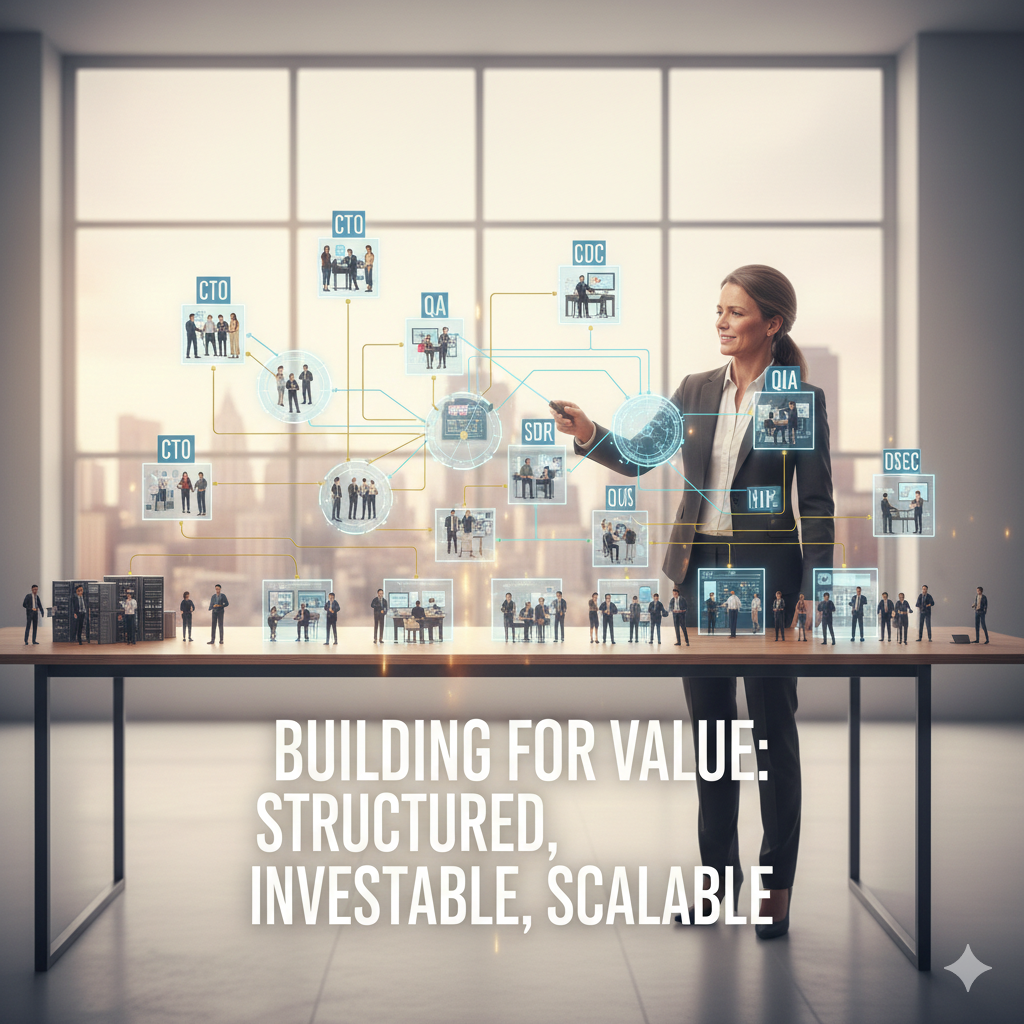
Once a SaaS business has validated its product and secured early revenue, the challenge changes.
The question is no longer “Can we build and sell this?”
It becomes “Can this business operate, scale, and grow without the founder doing everything?”
Years 1–2 are where value is either built quietly — or eroded unintentionally.
This phase marks the transition from a founder-led start-up to a structured, investable SaaS business. The decisions you make about people, roles, and ownership during this period have a direct impact on scalability, resilience, and eventual exit outcomes.
The core objective in Years 1–2 is simple:
Reduce founder dependency, strengthen core functions, and build the operational backbone of a business someone else could confidently buy.
1. From Lead Developer to CTO: Owning Technical Risk
As the product matures, engineering moves from reactive delivery to long-term technical stewardship.
Your early technical lead often evolves into a CTO role, taking responsibility for:
system architecture and scalability
security and data protection
technical debt management
development standards
long-term technical risk
For buyers and investors, this role is critical. A strong CTO reduces single-point dependency and reassures stakeholders that the product can scale safely.
2. Product Leadership: Translating Insight into Direction
As customer numbers grow, so does complexity.
A Head of Product brings discipline to:
customer insight and feedback loops
roadmap prioritisation
trade-offs between speed and quality
alignment between engineering, sales, and customer success
This role ensures product development is guided by evidence, not assumptions — a key signal of maturity in SaaS due diligence.
3. Sales Development: Building a Repeatable Pipeline
Growth becomes fragile when it relies solely on founder-led selling.
Introducing an SDR helps establish a predictable pipeline through:
structured outbound activity
lead qualification
early-stage conversations
consistent demo booking
This begins the shift from opportunistic revenue to a repeatable sales engine — something investors look for early.
4. Account Executives: Separating Strategy from Execution
As deal flow increases, the founder or sales lead must step back from day-to-day closing.
An Account Executive takes ownership of:
demos and negotiations
commercial conversations
contract progression
deal closure
This frees leadership to focus on pricing strategy, partnerships, and larger strategic opportunities.
5. Quality Assurance: Protecting Trust at Scale
As feature velocity increases, quality becomes a commercial issue.
I worked to a QA testing consultancy for a few years and I saw that by introducing QA our clients achieved:
structured testing
release discipline
reduced customer-impacting bugs
confidence in deployments
In SaaS, reliability directly affects retention — and retention drives valuation.
6. Growth Marketing: Scaling Demand Intentionally
Once messaging and product-market fit are proven, marketing shifts from experimentation to acceleration.
A growth-focused marketing lead helps:
generate consistent inbound leads
strengthen positioning
support sales enablement
build brand credibility
diversify acquisition channels
This reduces dependency on founder-led referrals and creates scale beyond networks.
7. Customer Success : Defending Lifetime Value
As the customer base expands, proactive customer success becomes essential.
Additional CSM or support capacity ensures:
structured onboarding
early identification of churn risk
renewal discipline
long-term account value growth
Strong customer success functions are often one of the most attractive assets in SaaS exits.
8. Part-Time HR: Avoiding Chaos Before It Starts
By 10–20 employees, informal people management starts to break.
Early, part-time HR support helps establish:
consistent hiring processes
effective onboarding
early cultural norms
performance conversations
basic compliance and documentation
This is not about bureaucracy. It’s about preventing people risk from becoming a blocker to growth or exit.
The Scaling Mindset: Build for the Business You’re Becoming
In Years 1–2, the goal is not to become corporate.
It is to introduce just enough structure to support:
clear accountability
repeatable processes
predictable revenue
stable delivery
a customer experience that scales
These foundations reduce risk, increase confidence, and materially improve exit readiness.
Final Thought
Early hires create momentum.
Scaling hires create stability.
When founders design their second layer with intention — rather than urgency — they build a SaaS business that can grow without burning out, and one that others can step into, invest in, or acquire.
I support founders in designing people and leadership structures in Years 1–2 that strengthen valuation, reduce dependency, and prepare the business for its next phase — whether that’s investment for scaling, or exit.
